Skip Content
You are currently on the new version of our website. Access the old version .

Metals

Metals is an international, peer-reviewed, open access journal published monthly online by MDPI.
The Spanish Materials Society (SOCIEMAT) is affiliated with Metals and their members receive discounts on the article processing charges.
Quartile Ranking JCR - Q2 (Metallurgy and Metallurgical Engineering)

All Articles (14,648)

The quality of the feedstock powder plays a key role in determining the properties of coatings produced by cold spray (CS). However, most commercially available powders are not specifically designed for CS, which makes it difficult to tailor powder characteristics for optimal performance. In this study, we examined the cold sprayability of five copper (Cu) powders manufactured using electrolysis, gas atomization, and mechanical grinding. The powders were characterized in terms of their microstructure, particle shape, and size distribution to evaluate how the production method influences powder properties. Powder flowability was measured using a shear cell test, while mechanical properties and deformability relevant to CS were assessed through nano-indentation. The results showed that gas-atomized powders with equiaxed grain structures offered the best combination of flowability and deformability, making them the most suitable for CS. Their spherical particle shape resulted in a lower surface area compared to the irregular electrolytic powder, which reduced inter-particle surface forces and allowed for smoother powder flow. Nano-indentation measurements indicated that the mechanically ground powder with ultra-fine grains and the gas-atomized powder containing fine dendrites had the highest nano-hardness values (HIT = 2.1 ± 0.15 GPa and 1.6 ± 0.1 GPa, respectively). In contrast, the porous electrolytic Cu powder showed the lowest hardness (HIT = 0.7 ± 0.2 GPa). These trends were confirmed by microstructural analysis of the deposited coatings. Coatings produced from the irregular electrolytic powder exhibited limited particle deformation, weak inter-particle bonding, and the highest porosity. Conversely, spherical gas-atomized powders produced much denser coatings. In particular, the powder with the most uniform spherical shape and no microsatellite particles resulted in the lowest coating porosity due to its superior deformation behavior upon impact.

7 February 2026
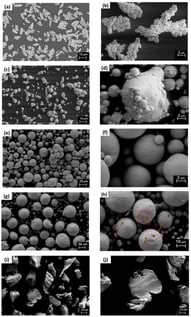
Low- and high-magnification SEM images showing the morphology of the as-received pure Cu powders: (a,b) powder A; (c,d) powder B; (e,f) powder C; (g,h) powder D; and (i,j) powder E. The red arrows in (h) indicate the presence of fine and coarse cellular structures.

The parametrization of the thermomechanical behavior of shape memory alloys (SMAs) under constant load is described in terms of their functional properties. The deformation–temperature–stress behavior of SMAs from various alloy systems—such as Ni-Ti, Ni-Ti-Cu, and Ni-Mn-Ga—was parametrized using a sigmoidal function. This approach enables the characterization of phase transformation parameters, including transformation temperatures, kinetic parameters, and the relationship between recoverable deformation and applied stress. It is shown that the sigmoid function can serve as a universal descriptor of thermoelastic phase transformations across different alloy systems and transformation types, such as B2–R–B19′–R–B2 (Ni-Ti-Cu), B2–R–B19′–B2 (Ni-Ti), and B2 (L21)–B19′ (L20)–B2 (L21). A correlation coefficient of approximately 0.99 was achieved. The present work extends the theoretical framework of diffuse martensitic transitions in SMAs, for which the sigmoid function has been theoretically derived to describe phase fractions. The article’s novelty lies in shifting from pure mathematical approximation (curve fitting) to physical parametrization of SMA behavior specifically under constant stress (actuator mode).

6 February 2026

Example of deformation temperature stress dependencies in interface of control program obtained for the sample of Ni-Ti alloy after equal angular pressing, hot forging, and annealing reprinting from [20]—raw data.

Laser powder bed fusion (LPBF) was adopted to manufacture AlSi10Mg, and two post-processing schedules, T4 (510 °C/2 h + water quench) and T6 (T4 + 180 °C/6 h), were applied to elucidate how Si precipitation size controls ductility. The as-built alloy consisted of an α-Al matrix with a grid-like eutectic Si network and achieved UTS > 480 MPa but exhibited build-direction-dependent tensile anisotropy. Heat treatment promoted Si precipitation from the supersaturated α-Al matrix and transformed the eutectic network via fragmentation, spheroidization, and Ostwald ripening, leading to pronounced softening and improved elongation. After T4, the yield strength and UTS decreased by >50%, while elongation increased from 10.9% to 22.27%; T6 provided a slight strength recovery accompanied by a marginal ductility reduction. Mechanistically, a high number density of fine Si precipitates enhances dislocation storage and delays damage accumulation, whereas coarse, non-shearable Si particles intensify local strain gradients, facilitate void nucleation at the matrix/particle interface, and accelerate fracture. Overall, tailoring Si precipitation/coarsening offers an effective route to improve ductility and mitigate anisotropy in LPBF AlSi10Mg.

6 February 2026

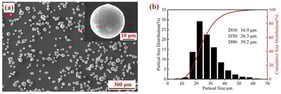
(a) SEM morphology of gas-atomized AlSi10Mg powder; (b) particle size distribution of the AlSi10Mg powder.

This study reviews the application of wire arc additive manufacturing (WAAM) technology in maritime engineering and investigates an experimentally driven analytical approach for prediction of thermal distributions based on the Rosenthal solution. Two ER70S-6 low-carbon steel WAAM cylinders were fabricated using gas metal arc welding (GMAW) and plasma arc welding (PAW) processes, with interlayer temperatures of 453 °C and 250 °C, respectively. Accurately measuring the temperature field to tailor the microstructure has long been a challenge. The results indicated a significant deviation between the analytical predictions and the experimental data. To address this discrepancy, a hybrid approach combining analytical and experimental results was implemented. Time intervals between layers, extracted from the experimental data, were incorporated into the Rosenthal equation to improve the accuracy of temperature field predictions. The microstructure at the bottom, middle, and top regions of the WAAM components was examined using optical microscopy. Tensile testing and Vickers microhardness measurements were conducted to evaluate mechanical properties. Scanning electron microscopy (SEM) was used to analyze fracture surfaces and identify fracture modes. The results were consistent with those reported for other ER70S-6 cylindrical WAAM components. This work highlights limitations of the Rosenthal solution and emphasizes the need for thermal models in WAAM applications.

5 February 2026

(a) Assembly of the blades on the hub and installation of the propeller on the Andromède [5]. Reprinted with permission from [5], 2023, Springer Nature. (b) Wire arc additive manufactured (WAAM) propeller bracket [7]. Reprinted with permission from [7], 2020, Elsevier.

News & Conferences

Issues

Open for Submission

Editor's Choice

Get Alerted

Add your email address to receive forthcoming issues of this journal.

XFacebookLinkedIn
Metals - ISSN 2075-4701